
From Car Exhaust to Oil Refining: How Important Are Rare Earth Catalytic Materials?
When it comes to rare earths, many people first think of new energy vehicles, wind power, robots, and neodymium-iron-boron magnets. But rare earths also have a very important, yet often overlooked, application: catalytic materials.

Rare Earth Catalytic Materials: The “Efficiency Amplifier” for Cleanliness
If rare earth permanent magnet materials underpin “electrification,” then rare earth catalytic materials underpin “cleanliness.” From automobile exhaust purification, petroleum refining, and industrial waste gas treatment to volatile organic compound (VOC) processing, hydrocarbon conversion, and catalysis for hydrogen and new energy, rare earth materials are indispensable.
The importance of rare earth catalytic materials lies not in the sheer volume used, but in their ability to make chemical reactions faster, more stable, and more controllable. To put it simply: rare earth catalytic materials act as the “efficiency amplifiers” in industrial reactions and environmental governance.
I. What are Catalytic Materials?
The role of catalytic materials is to accelerate the speed of chemical reactions without being significantly consumed themselves. In industrial production, catalysts are crucial. Without them, many reactions would be either too slow, require excessively high temperatures, consume too much energy, or produce too many by-products. With a catalyst, reactions can proceed faster, more energy-efficiently, and with greater selectivity.
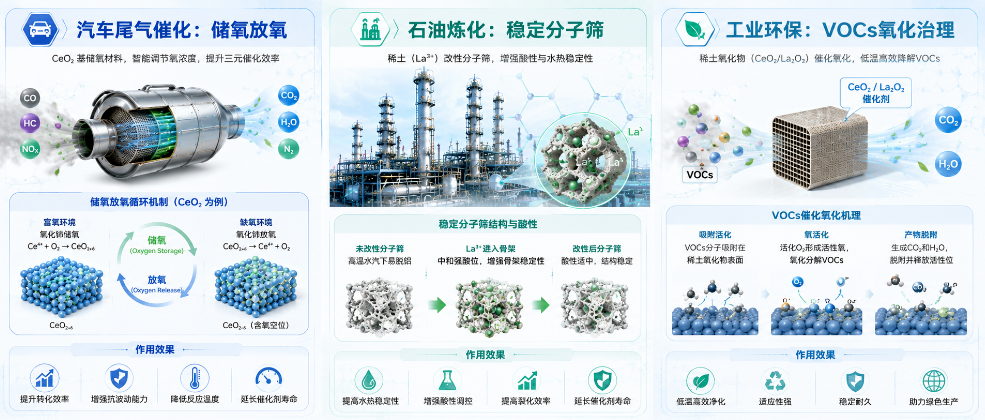
For example, carbon monoxide, nitrogen oxides, and unburned hydrocarbons in automobile exhaust need to be converted into relatively harmless carbon dioxide, water, and nitrogen under the action of a catalyst. Similarly, in petroleum refining, cracking heavy oil into more valuable products like gasoline and diesel is impossible without a catalytic system. Rare earth materials, especially light rare earths like cerium and lanthanum, play a vital role in these catalytic systems.
II. Why is Cerium the Star Element in Catalytic Materials?
Among rare earth catalytic materials, cerium is the most noteworthy. Its unique characteristic is its ability to reversibly convert between Ce³⁺ and Ce⁴⁺. This means that cerium oxide possesses a strong oxygen storage and release capacity.
Simply put: when the reaction environment is oxygen-rich, cerium oxide can “store oxygen”; when the environment is oxygen-deficient, it can “release oxygen.” This oxygen storage capacity is particularly critical for automobile exhaust purification. During a car’s operation, exhaust composition is not constant, and oxygen concentration fluctuates with engine conditions. If the catalyst cannot adapt to these changes, purification efficiency will drop. Cerium oxide and cerium-zirconium composite oxides can buffer these oxygen fluctuations, helping the catalytic system maintain stable operation. Therefore, in three-way catalysts for automobile exhaust, cerium-based materials are essential co-catalysts. They don’t just “participate briefly”; they help the entire catalytic system run stably and efficiently.
III. Why is Lanthanum Commonly Used in Petroleum Refining?
Besides cerium, lanthanum is also a key element in catalytic materials. Lanthanum-based materials are widely used in petroleum refining, particularly in fluid catalytic cracking (FCC) systems. Catalytic cracking converts heavy oil into valuable products like gasoline, diesel, and olefins. In this process, the catalyst must withstand high temperatures, steam, metal impurities, and complex hydrocarbon molecules over the long term.
Adding rare earth elements improves the stability, acidic structure, and hydrothermal resistance of zeolite catalysts, thereby extending catalyst life and reaction efficiency. Simply put, lanthanum’s role in refining catalysts is like “reinforcing the skeleton” of the catalyst. It helps the catalyst maintain its activity in high-temperature, high-moisture, and highly reactive environments. This is why rare earth catalytic materials have been a staple in the petrochemical industry for so long.
IV. Rare Earth Catalytic Materials Are Not Just “Environmental Materials”
Many people hear “catalysis” and immediately think of environmental protection. In reality, rare earth catalytic materials are used not only for pollution control but also to improve resource utilization efficiency. Applications include:
- Automobile exhaust purification
- Diesel vehicle aftertreatment
- Industrial VOC governance
- Petroleum cracking
- Methane catalytic combustion
- Carbon monoxide oxidation
- Nitrogen oxide reduction
- Hydrocarbon conversion
- Water-gas shift reaction
- New energy catalysis and oxygen storage materials
Behind these applications lie three core objectives: first, to make reactions faster; second, to lower energy consumption; and third, to ensure cleaner emissions. Therefore, rare earth catalytic materials are essentially a crucial pillar for green manufacturing and highly efficient chemical engineering.
V. Why Can Rare Earths Improve Catalytic Performance?
The functions of rare earth catalytic materials mainly include:
- Providing oxygen vacancies: The surfaces of rare earth oxides easily form oxygen vacancies. These defect sites participate in redox reactions, enhancing catalytic activity.
- Enhancing oxygen storage capacity: Rare earth oxides, represented by cerium oxide, can switch between different valence states to store and release oxygen.
- Improving thermal stability: Industrial catalysis often occurs at high temperatures, where catalysts are prone to sintering and deactivation. Rare earths help materials maintain structural stability.
- Improving support performance: Rare earths can adjust the acidity, structure, and stability of supports like alumina, zeolites, and zirconia.
- Reducing the pressure on precious metals: In automobile exhaust catalysis, precious metals like platinum, palladium, and rhodium are expensive. While rare earth materials cannot completely replace them, they improve the dispersion and utilization efficiency of precious metals, making the catalytic system more stable.
This is the true value of rare earth catalytic materials: they don’t perform solo; they make the entire catalytic system stronger.
VI. Why Are Cerium-Zirconium Composite Oxides Important?
In automobile exhaust catalysis, while pure cerium oxide has oxygen storage capacity, it may suffer from sintering and stability issues at high temperatures. Therefore, industry often combines cerium and zirconium to create cerium-zirconium composite oxides. These composites improve the material’s thermal stability, oxygen mobility, and oxygen storage performance. They are widely used in automobile exhaust purification systems and are typical rare earth functional oxides.
From a material R&D perspective, creating these composites is not simply mixing cerium oxide and zirconium oxide. It requires focusing on:
- Crystal phase structure
- Specific surface area
- Pore structure
- Oxygen vacancy concentration
- Ce³⁺/Ce⁴⁺ ratio
- Performance after high-temperature aging
- Dispersion of loaded precious metals
These indicators determine whether the material is truly suitable for industrial catalytic applications.
VII. Do Rare Earth Catalytic Materials Still Matter for New Energy Vehicles?
Yes, they do. Many assume that with the rise of new energy vehicles (NEVs), the demand for automobile exhaust catalysis will decline. However, it’s not as simple as “electric cars mean no catalysis.”
First, global combustion engine and hybrid vehicles will remain prevalent for a long time.
Second, scenarios like commercial vehicles, construction machinery, ships, and generator sets still require exhaust aftertreatment.
Third, plug-in hybrids and extended-range electric vehicles still have engines and require emission control.
Fourth, the new energy industry itself needs catalytic materials for hydrogen energy, fuel cells, green chemical engineering, energy storage materials, and carbon conversion.
Therefore, rare earth catalytic materials will not lose their significance with the advent of NEVs. On the contrary, they will expand from traditional exhaust treatment into the broader fields of green energy and low-carbon chemical engineering.
8. What really matters in rare earth catalytic materials?
It’s not just about the names of the elements. Having cerium or lanthanum in the formula doesn’t automatically make it a good catalyst. The true performance is determined by: particle size, specific surface area, pore structure, crystal phase, oxygen vacancies, surface valence states, thermal stability, integration with the support, and synergistic effects with noble metals or other active components.
This is exactly why some cerium oxide is only good enough for basic powder applications, while other grades are essential for automotive exhaust catalysts and high-end functional materials. In the materials industry, the real barrier to entry isn’t “knowing which elements to use,” but rather “knowing how to engineer these elements into useful structures.”
Conclusion
Why are rare earth catalytic materials so important? Because they are the bridge connecting environmental protection, energy, chemical engineering, and material upgrades. Cerium helps exhaust catalytic systems store and release oxygen; lanthanum boosts the stability of fluid catalytic cracking catalysts; cerium-zirconium composite oxides provide the backbone for high-temperature exhaust purification; rare earth zeolites serve oil refining and chemical conversion; and rare earth oxides are making their way into VOCs treatment, hydrogen energy, and green chemistry.
Rare earths aren’t just confined to the motors of new energy vehicles. They are also found in automotive catalytic converters, oil refining units, industrial environmental treatment systems, and the foundational materials of green, low-carbon manufacturing. Understanding rare earth catalytic materials is the key to grasping another crucial track in the rare earth industry.